
Landing Page Form Friction: What Happened When Companies Asked for Less
Evidence from published form and journey experiments shows how progressive fields, shorter processes, and clearer paths affected lead and conversion rates.
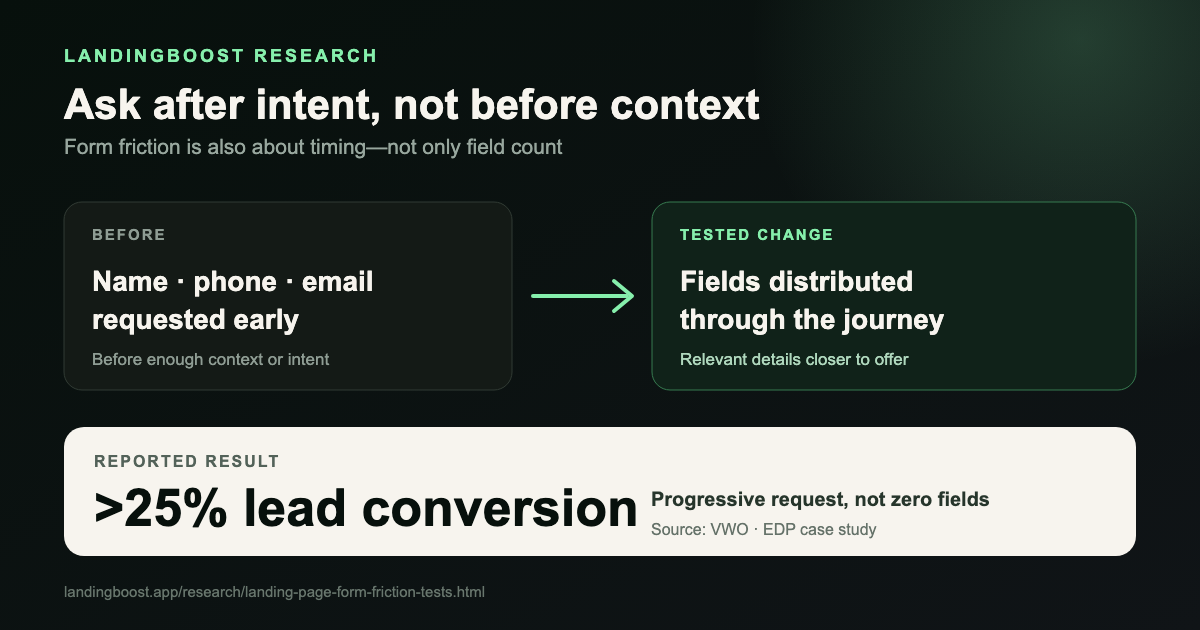
The practical pattern
- Ask only for information that is necessary at the visitor's current stage.
- Reduce perceived effort as well as literal field count: order, grouping, and timing matter.
- Measure the completed lead or purchase, not only focus or clicks on a form field.
Published experiments
What changed, what the source measured, and what the result does—or does not—prove.
Lead conversion
How to interpret it: The result supports changing when data is requested, not simply removing all fields. The broader CRO program also reported ROI, but that program-level result is not attributed to this one test.
Read the primary case study at VWO →Order conversion
How to interpret it: This is an older publisher example and a multi-part process change. It is evidence that perceived effort matters, not a forecast for a modern SaaS signup form.
Read the primary case study at MarketingExperiments →Lead form submissions
How to interpret it: This reduced journey friction rather than form fields. It shows that the path into a form can matter as much as the form itself.
Read the primary case study at VWO →Questions founders ask
How many fields should a landing page form have?
There is no fixed number. Ask for the minimum information needed for the current step, and defer fields that require trust or effort until the visitor has enough context.
Does removing form fields increase conversions?
It can, but the examples here also improved timing, grouping, and the path to the form. Test completed leads and lead quality before declaring fewer fields the winner.
What is perceived form friction?
Perceived friction is how difficult or costly the process feels. Long pages, unclear requirements, too many decisions, and sensitive questions asked too early can create friction even when the field count is modest.
Method and limits
- This article uses public case studies from the LandingBoost CRO evidence registry.
- Evidence grade B means the source names a testable change and a measured result, but not every detail required for independent replication is public.
- Vendor-published success stories overrepresent winning tests. A result is a hypothesis input, not an expected uplift.
Related research
Find the first edit on your page
LandingBoost checks clarity, CTA strength, proof, trust, and friction, then prioritizes the first conversion gap to fix.
Find my first edit free