
Social Proof Tests: Where Testimonials and Logos Actually Worked
Published tests of testimonials and customer logos show that proof placement and proximity to the decision can matter more than simply adding a logo row.
The practical pattern
- Place proof beside the claim or decision it supports, not in a decorative strip far away.
- Use concrete customer language, identity, or outcome; generic praise carries less information.
- Separate isolated proof tests from redesigns that changed copy, layout, and proof together.
Published experiments
What changed, what the source measured, and what the result does—or does not—prove.
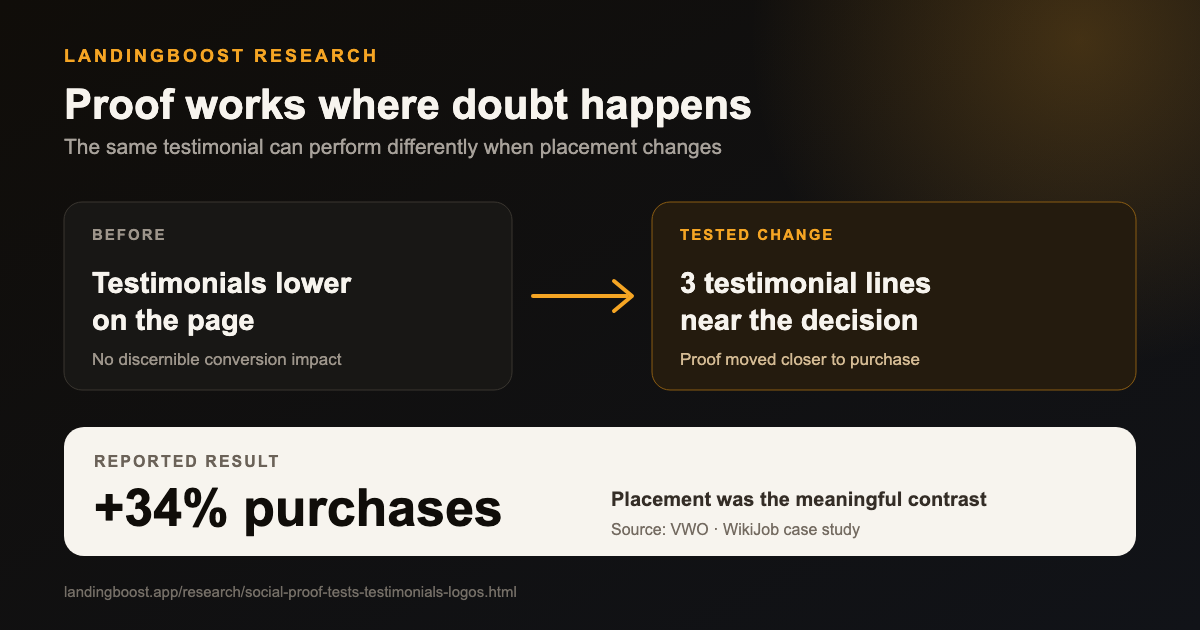
Purchases
How to interpret it: The public case makes placement the important contrast. It does not publish sample size or statistical confidence in the text available to us.
Read the primary case study at VWO →Free-trial signup conversion
How to interpret it: That is a 4.3 percentage-point increase, or roughly 11.9% relative uplift. The published case does not expose every experimental detail needed to generalize the result.
Read the primary case study at VWO →Signups
How to interpret it: A separate use-case variation also won at +8%, showing that proof and product relevance can both reduce uncertainty. This is one company's result, not an expected lift for every page.
Read the primary case study at Conversion →Questions founders ask
Where should testimonials go on a landing page?
Put the most relevant proof close to the claim, CTA, or purchase decision it supports. WikiJob's published case suggests the same proof can perform differently when its placement changes.
Are customer logos enough for social proof?
Logos can reduce perceived risk, but they rarely explain an outcome. Combine recognizable logos with a concrete customer result when you can substantiate it.
How do I test social proof?
Change one proof variable at a time—placement, specificity, customer identity, or format—and measure signups or purchases. Do not attribute a full-page redesign's uplift to testimonials alone.
Method and limits
- This article uses public case studies from the LandingBoost CRO evidence registry.
- Evidence grade B means the source names a testable change and a measured result, but not every detail required for independent replication is public.
- Vendor-published success stories overrepresent winning tests. A result is a hypothesis input, not an expected uplift.
Related research
Find the first edit on your page
LandingBoost checks clarity, CTA strength, proof, trust, and friction, then prioritizes the first conversion gap to fix.
Find my first edit free