
SaaS Value Proposition Examples: What Changed Signups and Purchases
LandingBoost reviewed 107 value-proposition CRO records to show which SaaS message changes improved signups, demo clicks, and purchases, plus where they failed.
Key results
- The repeatable examples explain the offer, next step, or plan difference more clearly; they are rarely just slogan changes.
- Homepage clarity matters, but pricing, signup, and checkout pages show nearly as much message evidence in the registry.
- Familiar buyer language and lower commitment near the CTA recur more often than clever wording.
- Negative examples exist, so a louder offer can still reduce transactions when it does not match buyer reality.
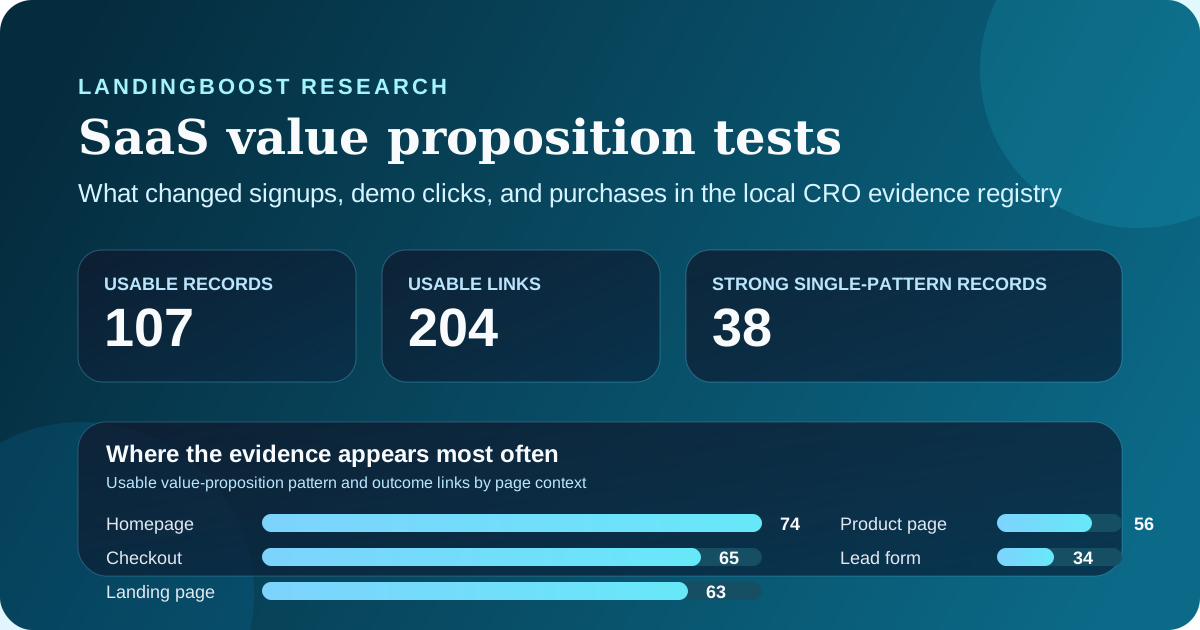
Where value-proposition evidence appears most often
Usable value-proposition intervention and outcome links in the local registry. These are pattern associations, not unique experiments, so the totals exceed 107 records.
| Dimension | Usable links | How to interpret it |
|---|---|---|
| Homepage | 74 | The hero still carries the first job: explain outcome and audience before the visitor decides whether the rest of the page is worth reading. |
| Checkout | 65 | Offer clarity keeps mattering near purchase; unclear plan language or a mismatched promise can still depress transactions late in the funnel. |
| Landing page | 63 | Dedicated campaign pages often win by aligning the headline and CTA with the visitor's immediate problem, not by adding more persuasion blocks. |
| Product page | 56 | The product page is where category language, screenshots, and proof have to turn interest into an understandable buying case. |
| Lead form | 34 | Form pages still need message work: explain what happens next, what the prospect gets, and why the request is worth the effort. |
What the best examples actually change
The local registry entry behind this topic reports 107 usable records, 204 usable pattern and outcome links, and 38 strong single-pattern records for value proposition and message clarity. That is enough repetition to treat message work as a serious hypothesis class. It is not enough to treat any one wording idea as reliable on its own.
The useful examples share a pattern: they remove interpretation work. In Conversion's Direct Energy archive, making the featured plan and promotion clearer on the plans page increased transactions by more than 13%. In the same program, changing the CTA from a more committal next step to 'Select Plan' was linked to an estimated 24% increase in transactions. The change was not clever copy. It simply matched the real action behind the click.
The same pattern appears in SaaS-specific cases. Orah tested homepage copy for new visitors and reported that using industry terms instead of brand-specific language increased request-a-demo clicks by 63.27%, product-page clicks by 101.41%, and free-signup clicks by 121.41%. Those are large reported lifts, but the portable lesson is smaller: visitors moved faster once the site described the product in terms they already understood.
- Clarify what the visitor gets, not just what the product is called.
- Lower commitment when the next click is only the next step, not the purchase itself.
- Use language the buyer already uses in search, sales calls, or category comparisons.
Where message work keeps showing up in SaaS funnels
Homepage clarity leads the evidence mix, but pricing and conversion-path pages are close behind. The pattern-coverage report counted 74 homepage links, 65 checkout links, 63 landing-page links, 56 product-page links, and 34 lead-form links for this pattern. That matters because founders often treat value proposition work as a hero-headline task, even though the buyer has to keep understanding the offer when pricing, signup, and plan choice become more concrete.
Pricing-page examples reinforce that point. BaseKit described its winning variant as 'bolder, brighter, clearer pricing' with a testimonial and more obvious currency selection, and reported a consistent 25% conversion improvement. Restroworks added a 'Why POSist?' section, logos, testimonials, and clearer explanation of what the prospect would get; its homepage variant reported a 15.45% conversion rate versus 13.25% for the control, and the broader program later reported 52% more leads in a month. These are not pure copy-only tests, but they still show the same message principle: plan value has to be explicit where the decision is made.
- Treat the pricing page as value-proposition copy, not only as packaging or design.
- Make the post-click outcome visible near the form or demo CTA.
- If the buyer still has to translate your plan names or jargon, the message is not done yet.
Why some value-proposition tests still lose
The registry does include failure signals. The value-proposition pattern has 10 negative or neutral usable links, and the most obvious reason is relevance. In Conversion's Sport Chek archive, moving the free-shipping promise to '$75 or more' caused a nearly 15% decrease in transactions at 94% confidence, even though free shipping itself is normally a strong value cue. A stronger-sounding promise is not a better value proposition if it makes the offer less reachable for the actual buyer.
Message tests can also lose when they mismatch the traffic source or compress too much context. MarketingExperiments reported a headline test where the control ad outperformed the treatment by 36.18% in click-through rate. That is a useful warning against assuming that shorter, sharper, or more assertive language is automatically clearer.
The other limitation is source bias. Of the 204 usable links in the local pattern report, 157 came from VWO success stories, 27 from Conversion, 19 from MarketingExperiments, and one from the Qubit meta-analysis. Most records are grade B rather than grade A. So this dataset is useful for prioritization, pattern recognition, and hypothesis writing, but not for expected-lift claims or win-rate forecasting.
- A message becomes weaker when it raises the threshold or promise beyond what most visitors can actually get.
- Click-through lifts are useful only when the next-step quality metric also holds.
- Success-story archives are good for pattern discovery and bad for guaranteed outcomes.
Linked sources for the claims in this article
Questions founders ask
What makes a SaaS value proposition example useful?
A useful example reduces buyer interpretation work. It explains the outcome, audience, next step, or plan difference in language the prospect already understands, and it measures something downstream such as demo requests, signups, purchases, or revenue.
Should I test the homepage headline or the pricing page first?
Start where the buyer is getting lost. The registry shows message evidence on homepages, pricing pages, product pages, lead forms, and checkout flows. If visitors click but stall later, the pricing or signup page may be the higher-leverage test than the hero headline.
Do CTA wording changes count as value proposition work?
Sometimes. A CTA change matters when it clarifies the real next step or lowers unnecessary commitment. Direct Energy's move from a more committal CTA to 'Select Plan' is a good example because the wording matched the actual action behind the click.
Can I expect the same uplift these examples reported?
No. The registry is built mainly from public success stories and mostly B-grade evidence, so the reported lifts are historical outcomes in other contexts. Use them to prioritize hypotheses, then validate with your own downstream metric.
Method and limits
- Aggregate counts in this article come from the local CRO evidence registry entry for the value_proposition pattern, generated on 2026-07-15 and stored in reports/pattern-coverage.json.
- The report counted 204 usable intervention and outcome links across 107 unique records; page-context subtotals are associations, not unique experiments.
- LandingBoost reviewed short factual extracts, not full article bodies or third-party screenshots, and preserved the source-library rights notes in the source section.
- The evidence mix is dominated by success-story archives and mostly grade B records, so the data is descriptive and suitable for prioritization, not expected-uplift claims.
- VWO and Conversion.com facts are retained under public-facts-only rights notes with commercial reuse not cleared; this article republishes only summarized facts with attribution.
Useful next steps
Related research
Find the first testable edit on your page
LandingBoost checks clarity, CTA strength, proof, trust, and friction, then prioritizes the first conversion gap to fix.
Find my first edit free