
How to Build Trust on a SaaS Landing Page Without Testimonials
A 48-domain LandingBoost study shows where SaaS proof goes missing and gives founders an honest trust stack to use before testimonials exist.
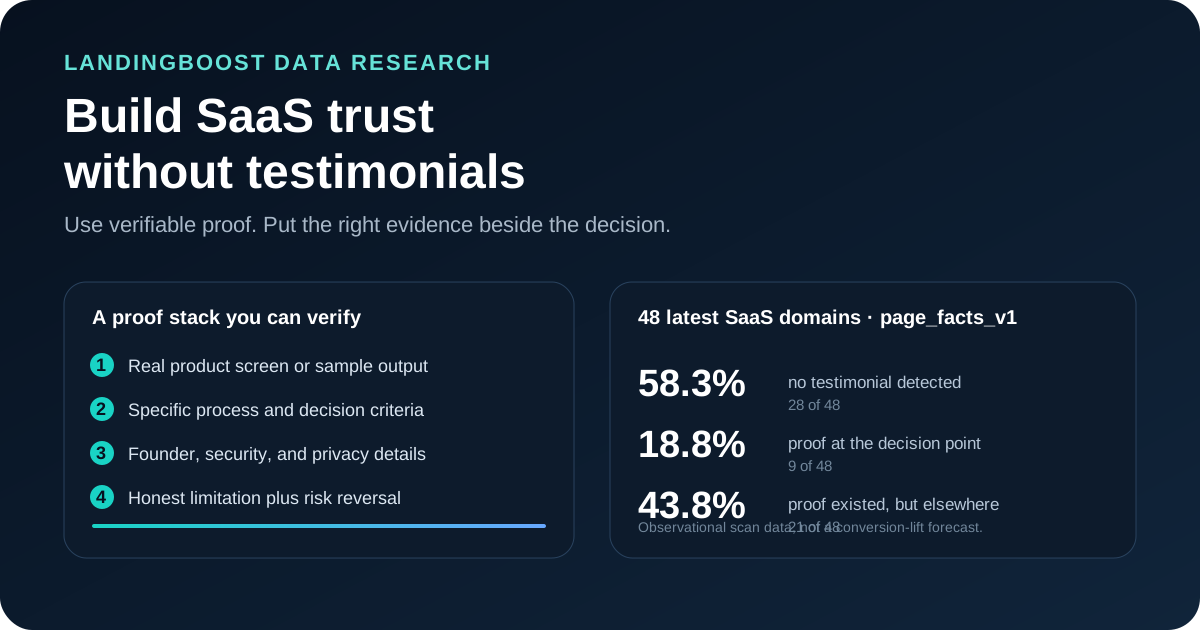
Key results
- Testimonials are one form of proof, not the definition of trust. Early products can show product, process, identity, safety, and risk-reversal evidence instead.
- In the 48-domain structured sample, 28 pages had no detected testimonial, yet 30 still had some other detectable proof. The practical question is what evidence exists and where it appears.
- Only 9 of 48 pages placed detected proof at the decision point. Twenty-one had proof elsewhere, which makes placement a distinct diagnosis from proof absence.
- The dataset cannot establish a universal pixel distance or forecast a conversion lift. It is strong enough to prioritize a manual trust review and a measurable placement test.
What the structured SaaS scans detected
Latest valid scan per unique SaaS domain with page_facts_v1, August 4–September 9, 2026. Categories overlap: a page without testimonials can still contain another kind of proof.
| Dimension | Share of 48 domains | How to interpret it |
|---|---|---|
| Trust was the primary bottleneck | 89.6% · 43/48 | The scan prioritized Trust first. This is a diagnostic ranking, not evidence that Trust caused lost conversions. |
| Trust score below 60 | 70.8% · 34/48 | A low Trust score was common in this structured subset, but scores are not conversion rates. |
| No testimonial detected | 58.3% · 28/48 | The capture found no testimonial-like item. It may still have found product, process, identity, or risk-reversal proof. |
| Proof existed, but not at decision point | 43.8% · 21/48 | Evidence was detected somewhere on the page but not classified beside the primary decision. |
| Proof at decision point | 18.8% · 9/48 | Detected proof was close enough to support the primary action. The study does not publish a universal pixel threshold. |
| No detectable proof | 37.5% · 18/48 | No proof was detected in the captured page. Hidden, gated, or failed-to-render content may be missed. |
What trust means before testimonials exist
A testimonial is useful because it transfers another person's credibility to the product. But the buyer's underlying question is broader: is this real, is it for someone like me, will it work as described, and what happens if it does not? A new SaaS can answer those questions without pretending to have customers it does not have.
Start with evidence the visitor can verify. Show the actual interface, a sample report, or the output they will receive. Explain the process in concrete steps and name the inputs, limits, and expected next action. Identify the founder or company and provide a real way to contact them. State current privacy, security, cancellation, trial, or refund facts only when they are true. An honest limitation can increase confidence because it makes the rest of the promise easier to believe.
Do not replace missing testimonials with vague badges or unsupported numbers. A row of invented avatars, customer logos without permission, an unverified user count, or a performance claim without a measurement trail creates more risk than it removes. If a fact cannot be checked internally and defended publicly, it does not belong in the proof layer.
- Product proof: a real screen, sample output, public demo, or worked example.
- Process proof: what the product checks, how it decides, and what the user receives.
- Identity proof: a named founder or company, contact path, and relevant background without inflated credentials.
- Safety proof: accurate privacy, security, billing, cancellation, trial, or guarantee information.
- Constraint proof: who the product is not for and what it cannot promise.
What the 48-domain sample says—and does not say
LandingBoost queried the latest valid scan for each normalized external domain classified as SaaS and retained only rows with the page_facts_v1 structure. That produced 48 unique domains scanned from August 4 through September 9, 2026. Twenty-eight of the 48 had no detected testimonial. Forty had no detected outcome testimonial, meaning the capture did not find a customer statement with a specific result signal.
The more useful split is placement. Nine of 48 had proof classified at the decision point. Twenty-one had proof somewhere else on the page but not at that point, while 18 had no detectable proof. Those groups sum to 48. They show why 'add testimonials' is often too generic: some pages need a credible proof asset, while others already have evidence and need to connect it to the action it supports.
This sample is observational and small. It does not measure what happened to signups after proof moved, and it does not represent every SaaS landing page. Detection can also miss content behind a carousel, consent layer, interaction, authentication, or incomplete capture. Use the counts to choose what to inspect, not to promise that a placement change will raise conversion by a particular amount.
Where to place proof near the CTA
Place proof according to the objection at that decision, not according to a universal template. For a homepage CTA that asks for a URL, the relevant proof may be a real sample result and a short privacy statement. For a paid checkout, it may be current billing terms, cancellation details, security facts, or a guarantee. For a demo request, it may be the expected agenda, the person who will respond, and a concrete example of the outcome.
A useful first test is one compact proof unit immediately below or beside the primary CTA. It should be readable without scrolling away from the action and specific enough to answer one objection. Keep the detailed evidence lower on the page and link to it when necessary. The compact unit and the detailed section should say the same thing; do not use microcopy to make a stronger promise than the underlying evidence supports.
LandingBoost does not publish a universal pixel-distance rule from this dataset because too few records contain reliable rectangles for both the CTA and proof. 'At the decision point' is therefore a structured classification, not a claim that every proof item must sit a fixed number of pixels from a button. Verify the final placement on desktop and mobile, then measure the downstream action that matters.
- Under a free scan CTA: show a sample result, what data is used, and whether an account or card is required.
- Near a trial CTA: show the real product, the time to first value, billing start, and cancellation terms.
- Near a demo CTA: show who the call is for, what will happen, and one relevant customer or product example if it is genuine.
- Near checkout: show current price, renewal terms, refund or guarantee facts, security details, and support access.
A no-fabrication proof stack for an early SaaS
Use the strongest proof you can substantiate today, then upgrade the stack as evidence arrives. Stage one is demonstrability: let the buyer inspect the product or a representative output. Stage two is transparency: explain the workflow, inputs, limits, pricing, privacy, and owner. Stage three is observed usage: publish only verified counts or anonymized patterns with a date, denominator, and method. Stage four is customer evidence: add a quote or case study only with permission and enough context to understand what changed.
The sequence matters because it avoids waiting for testimonials before making the page credible. It also avoids the opposite mistake of presenting a single friendly quote as proof that the whole product works for everyone. A testimonial should identify the situation it speaks to. A product sample should show what the visitor receives. A dataset should state how records were selected. Each asset has a different job.
Before publishing any proof claim, keep a small evidence ledger: exact claim, source, date checked, owner, permission status, and page locations where it appears. If the source changes—pricing, a user count, a security control, or a quote—the ledger makes the stale claim findable. This is less glamorous than a logo wall and far safer for a one-time-purchase product where a broken promise can lose the buyer permanently.
The first test to run
Choose the primary CTA and write down the uncertainty that could stop a qualified visitor there. Then select one existing, verifiable asset that directly answers it. If no asset exists, create the smallest honest one: a real output example, a two-minute product walkthrough, a plain-language methodology note, founder identity, or accurate risk-reversal copy. Put that unit at the decision point without removing the fuller explanation elsewhere.
Track the CTA click and the next meaningful step, such as scan completion, account creation, activated trial, qualified demo, or purchase. Compare a stable period before and after the edit, and note any traffic or offer changes. With low traffic, use the result as directional evidence and keep collecting observations instead of declaring a winner after a handful of sessions.
If the proof is already present but visitors still hesitate, investigate whether it is relevant, legible, believable, and connected to the CTA. If proof is absent, create it before optimizing its position. That distinction is the main practical lesson from the 48-domain sample: absence and distance are different problems and should not receive the same generic recommendation.
Linked sources for the claims in this article
Questions founders ask
How do I build trust on a SaaS landing page without testimonials?
Show evidence a visitor can verify: the real product or sample output, a specific process, founder or company identity, accurate privacy and security facts, honest limitations, and a low-risk next step. Put the most relevant item beside the CTA it supports.
Should I invent example testimonials for a new SaaS?
No. Do not invent quotes, logos, avatars, user counts, or performance results. Label a hypothetical scenario as an example, and keep it separate from customer evidence.
What should go under the CTA when I have no customers?
Use one compact, true risk reducer matched to the action: a sample output, no-card or cancellation terms, privacy facts, time to first value, or what happens next. Link to fuller evidence when the detail cannot fit beside the CTA.
Does moving proof closer to a CTA always increase conversion?
No. This study detected whether proof was at the decision point; it did not run randomized placement experiments. Treat placement as a hypothesis and measure the next meaningful action on your own page.
Why does the article use 48 domains instead of all LandingBoost scans?
The trust-without-testimonials breakdown requires the newer page_facts_v1 fields. The article keeps only the latest valid scan for each external SaaS domain with those fields, so the structured denominator is 48 and is not mixed with older scan generations.
Method and limits
- The source is LandingBoost lp_scan_history. The article uses the latest valid scan per normalized external domain where page_category equals saas and full_result.page_facts uses page_facts_v1.
- A valid row has a non-null full result, an overall score from 1 to 100, and Clarity, Relevance, Trust, and Action scores from 0 to 100. LandingBoost, localhost, 127.0.0.1, and blank domains are excluded.
- The 48 scans span August 4 through September 9, 2026. Twenty records use category version 3 and 28 use category version 4; all use the same page_facts_v1 proof fields. Score comparisons should therefore be treated as diagnostic observations, not a controlled benchmark.
- Proof counts come from proof.exists_somewhere and proof.at_decision_point. Testimonial counts come from proof.testimonial_count and proof.outcome_testimonial_count. Zero means not detected in the captured page, not proof that the item does not exist elsewhere.
- No customer URLs, copy, screenshots, email addresses, or user identifiers are published. Counts are observational and cannot establish causality or expected conversion uplift.
Useful next steps
Related research
Find the first testable edit on your page
LandingBoost checks clarity, CTA strength, proof, trust, and friction, then prioritizes the first conversion gap to fix.
Find my first edit free